Table of Contents
Spider Mites

Overview
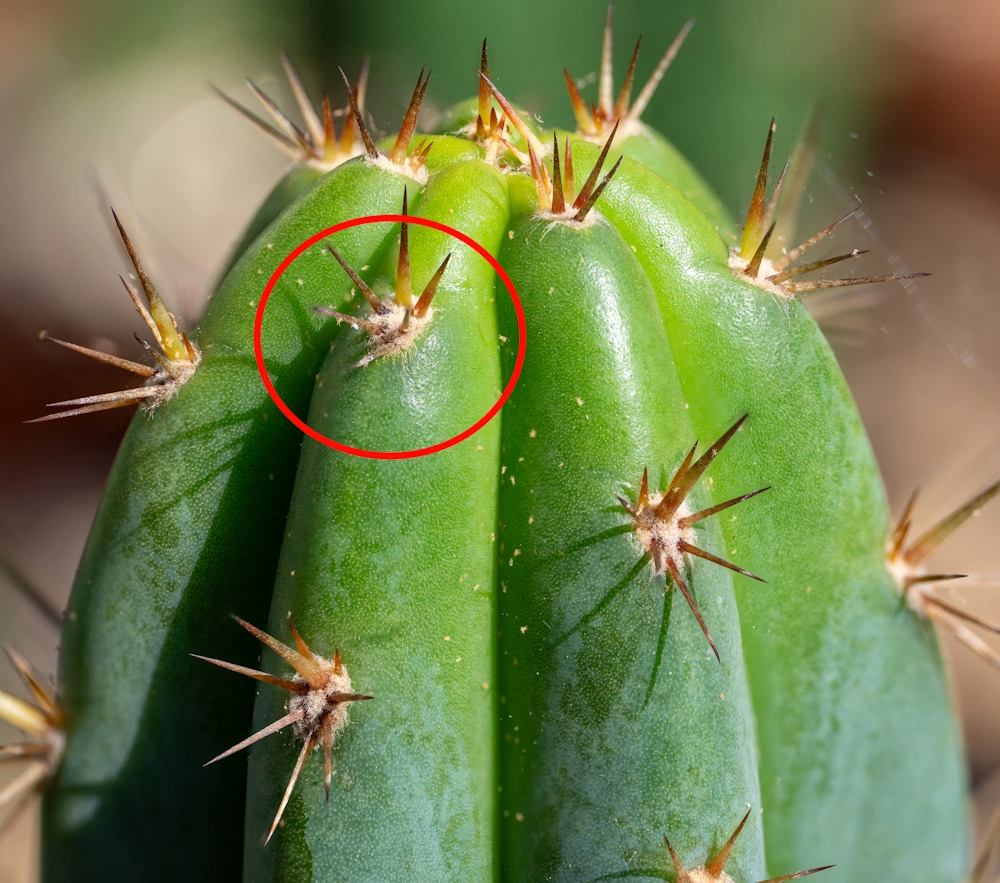
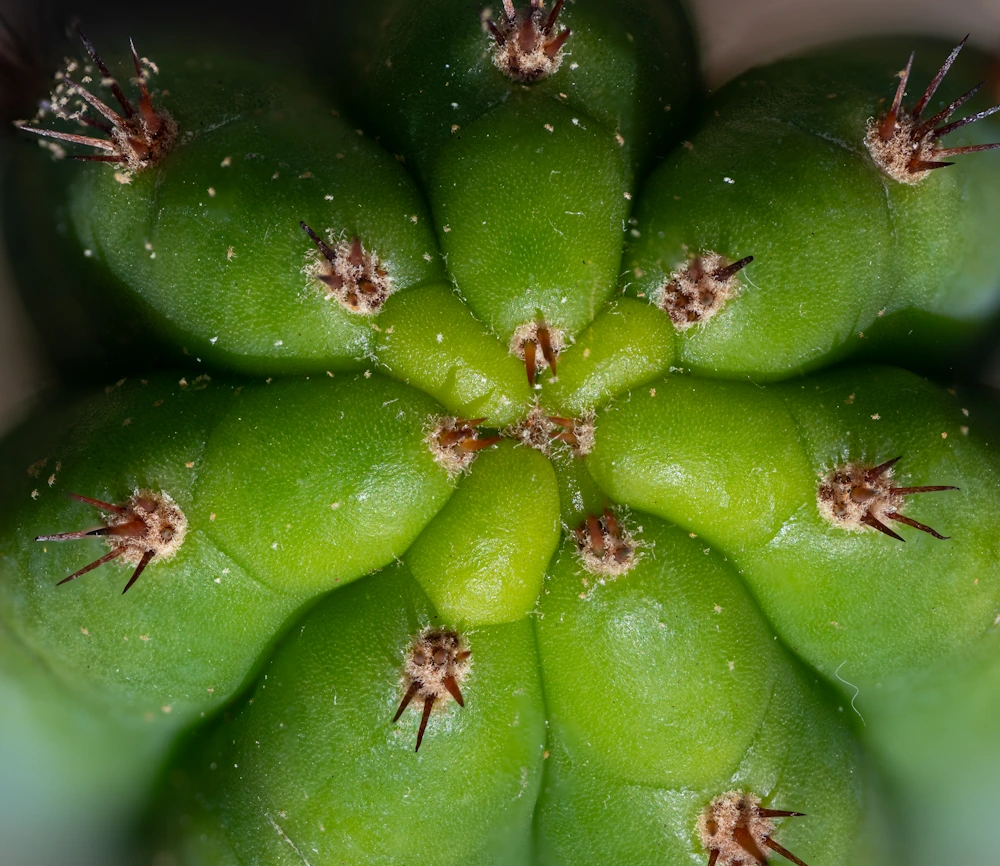
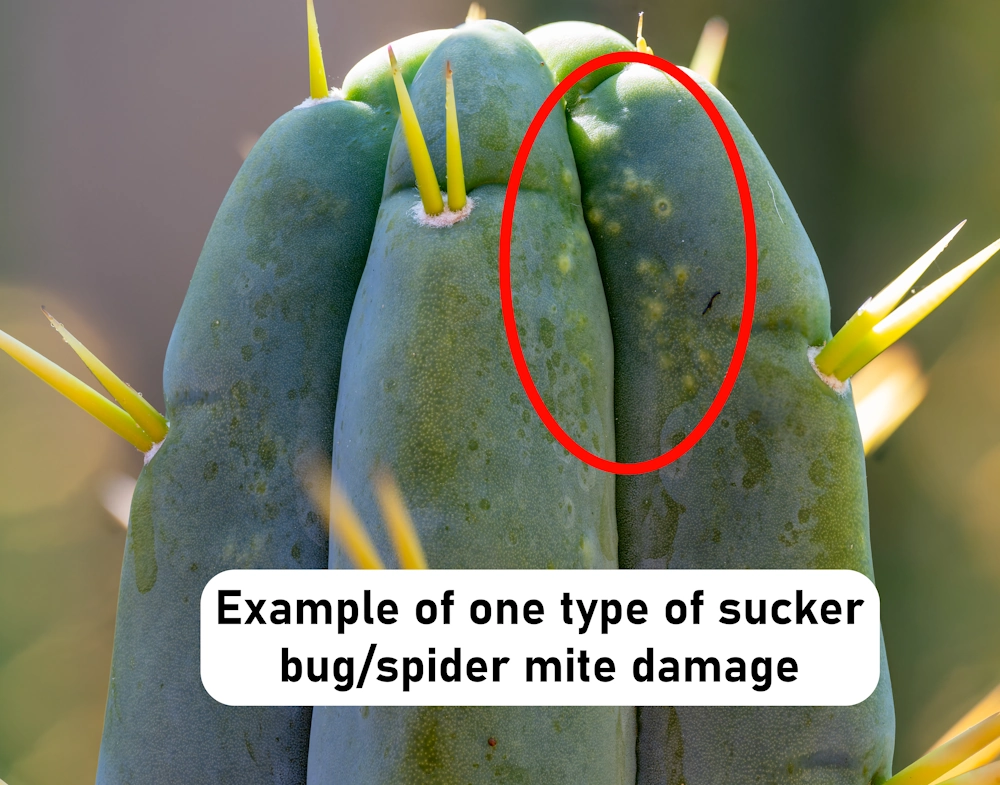
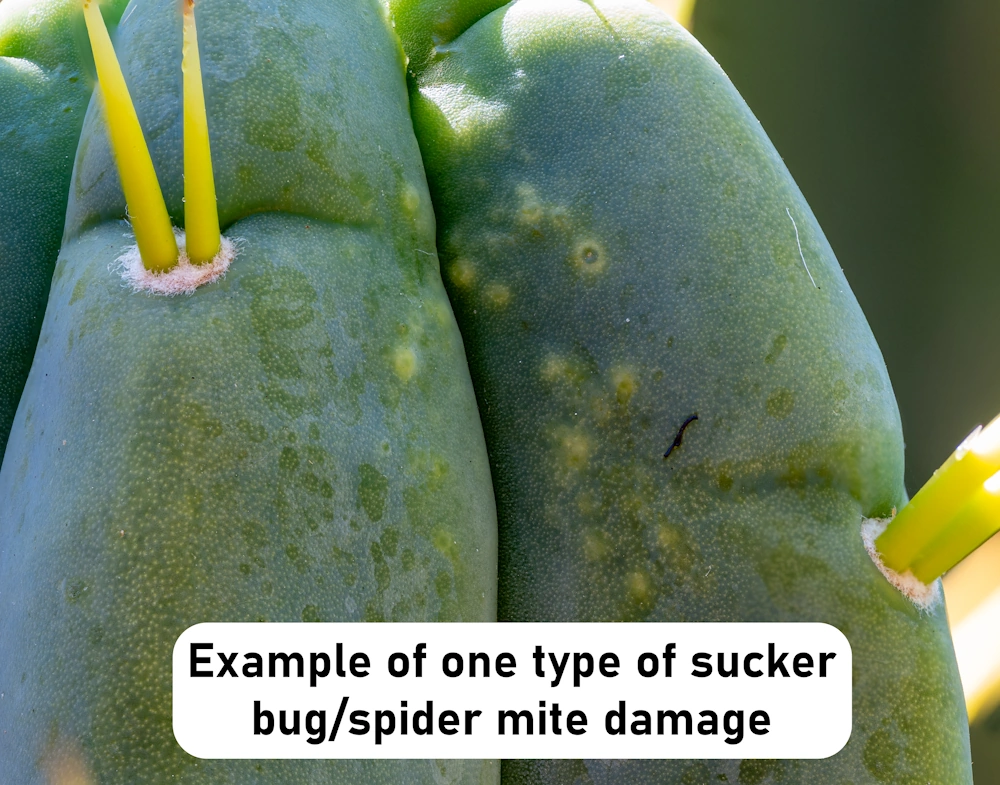
Spider mites are small arachnid pests that target cacti, often feeding on the plant's tender growing tips. While they are relatively easy to control on cacti compared to leafy plants, they can cause permanent aesthetic damage and weaken the plant if left unchecked. This type of sucker class pest can also be a vector for spread of more serious disease. Managing them effectively requires breaking their reproductive cycle and avoiding treatments that inadvertently destroy their natural predators.
Symptoms & Identification
Spider mites can be tricky to distinguish from predatory mites or tiny spiders, which are beneficial. If you see numerous stationary or slow moving mites on it, some of which suspended a small distance off of the plant with nearly invisible webbing, this is a strong sign of spider mites. They congregate near tips, in crevices between ribs and in with spines. Spider mites can be white, white with a black dot on each side, orange, or red. Spiders (the non mite type) are often solitary unless they are very young, and beneficial mites do not produce webbing and move significantly quicker. Over time, their feeding damage can lead to secondary issues, such as rust infections.
When identifying mites, growers should observe their movement speed to distinguish pests from beneficial predatory mites:
- Pest Mites: Move slowly, small enough to be nearly invisible to the naked eye, nearly invisible webbing may be present.
- Predatory Mites: Beneficial. Move noticeably faster as they actively hunt for prey. Larger, though still tiny. Easily visible with the naked eye.
Cause & Spread
Spider mites are arachnids, not insects. They reproduce rapidly, and their populations can explode if their natural predators are eliminated. A common cause of population spikes is the improper use of systemic insect control granules (such as those designed for houseplants). Because these granules target insects rather than arachnids, they fail to kill the spider mites while successfully eliminating the beneficial predatory insects that keep mite populations in check.
Treatment & Management
- Water Spray: Hosing the mites off the plant is a good initial step to reduce their numbers. A strong direct blast from the hose to your columns tips on occasion is a good preventative for many tiny pests.
- Spinosad (e.g., Captain Jack's Dead Bug): Spider mites are known to build resistance to spinosad within a few generations. If it's all you have on hand it can greatly cut their numbers for a week or two, but long term they will multiply and an alternate treatment will most likely be necessary. Apply at dusk/lights out, apply 4-5 times at intervals based on life cycle - evey 3 days in warmer weather up to every 7 days in cooler weather.
- Flying Skull Nuke Em: Food safe alternative to spinosad. Citric acid based. Apply just like spinosad, but mites will not build resistance to it. Using it and spinosad alternating from early treatment is highly effective. Product can be difficult or impossible to get in some localities.
- Azamax: Alternate effective miticide option. Possible side effects to plants include phytosensitivity.
- Diatomaceous Earth (DE) & wettable sulphur: DE an be mixed heavily into the soil or mixed 50/50 with sulphur to dust the plants. *Caution:* non-selective and will harm beneficial insects and pollinators. Additionally, growers must wear a mask when handling to avoid inhaling the dust, which is hazardous to the lungs. Dusting will damage farina and permanently alter plant skin appearance.
- Avoid Systemic Insecticides: Do not use standard systemic insect granules (designed for insects) to treat spider mites, as this will worsen the infestation by killing predatory insects.
Biological Controls (Integrated Pest Management)
Introducing predatory mites is a highly effective natural control method including *Amblyseius californicus* or *Phytoseiulus persimilis*, depending on your local climate.
Notes & Contradictions
- Gee Bee's Participation: Gee Bee did not participate in this discussion thread.
- Diatomaceous Earth Disagreement: While Jesse Joseph Scrabonia advocates for heavy use of diatomaceous earth (DE) mixed into soil and dusted on plants to kill pests, Chris Salvin strongly cautions against it, noting that DE is “gnarly stuff” because it indiscriminately harms beneficial insects and pollinators. Furthermore, Kevin Earl Rasmuson and Julie Wolf emphasize that DE poses a severe inhalation hazard to humans and should never be handled without a mask.
- Insecticides vs. Miticides: Daryl Lee DeWeese Jr. initially attempted to use systemic insect granules to treat a mite issue. Lee Hatcher corrected this approach, explaining that because mites are arachnids, insect-specific systemics will not kill them and will instead exacerbate the infestation by eliminating the mites' natural predators.
- Soil Mites vs. Pest Mites: Nick VanWagner identified Jelle Buntinx's mites as harmless soil mites under a scope, but Jelle Buntinx noted that they had destroyed growth and required cutting, highlighting the difficulty in distinguishing beneficial soil mites from destructive pests without close observation.
References
* Topic Authority: Gee Bee did not participate in this discussion. * Contributors: Wilfy Fletcher, Pete Young, Isaac Taylor, Mandel Brot, Lee Hatcher, Daryl Lee DeWeese Jr., Jesse Joseph Scrabonia, Anton Kucharski, Mark Lyon, Chris Salvin, Chris Chu, Kevin Earl Rasmuson, Julie Wolf, Jasper Peeters, Darren B Spicer, Frank Rizzo, RC Figueroa, Jelle Buntinx, Nick VanWagner, Matt Heite, Chris Smoknofften, Jon Young, Maria Megalogeni, Jan Ratcliffe, Rex Hammack. * Photo Credits: Jelle Buntinx, Jon Young, Julie Wolf, RC Figueroa, Anton Kucharski, Daryl Lee DeWeese Jr., Pete Young.