
This is an old revision of the document!
Table of Contents
Pot selection and building your substrate
One of the most important parts of setting up your cacti for success is choosing their homes - pots and substrate. Choosing these go hand in hand with each other.
Note: These are recommendations for seedlings through mature cacti. For germinating seeds, see the germination section of the wiki.
Pot selection
All pots for cacti should have drainage holes and no attached saucer. If you must use a pot with no holes or an attached saucer you can drill your own new holes through it. Excessively large drainage holes can allow the substrate to wash out of the pot. To prevent this you can add window screen or mesh fiberglass drywall tape inside over the holes. Their root growth matches with pots that are roughly as deep as they are wide. Square pots, though a luxury, are an improvement over circular ones due to space efficiency and root circling prevention. I have found these cacti really do not do well in glazed ceramic pots. For mature size columns, 3 or 5 gallon containers work fine. Keeping the volume lower and letting them get root bound can lead to early flowering at the expense of growth rate. For mature columns and stands, the optimal pot type depends on your climate. Fabric pots will dry fairly quickly and do a bit of “air root pruning” but if moved they can destabilize the roots and lead to leaning or tippy plants. Plastic is much more stable and holds moisture a little longer which can be an improvement for very dry climates, but in direct sun they can lead to very high root zone temperatures. Unglazed terracotta pots dry more quickly than necessary for most climates and may require more frequent watering, but in the most wet and humid climates may be the best choice. On the downside, terracotta are the most expensive, the roots often cling to the pots walls as they may hold moisture longer than the substrate, and you may need to break the pot during future unpotting.
Up potting through growth stages
When first potting up out of germination trays, plastic cell trays or small plastic pots work best, because terracotta or fabric will dry small soil volumes too quickly for optimal yearling health. For example, a good progression would look like 2.7 inch cells from about 1.5” to 8” tall and up into half gallon plastic pots from about 8” to 16” tall, finally into their mature homes: 3 to 5 gallon fabric or plastic pots.
Substrate
Almost all pre-bagged cactus soil is pretty bad. Make your own mix.
Lazy soil recipe
35% peat free garden soil. 65% pumice.
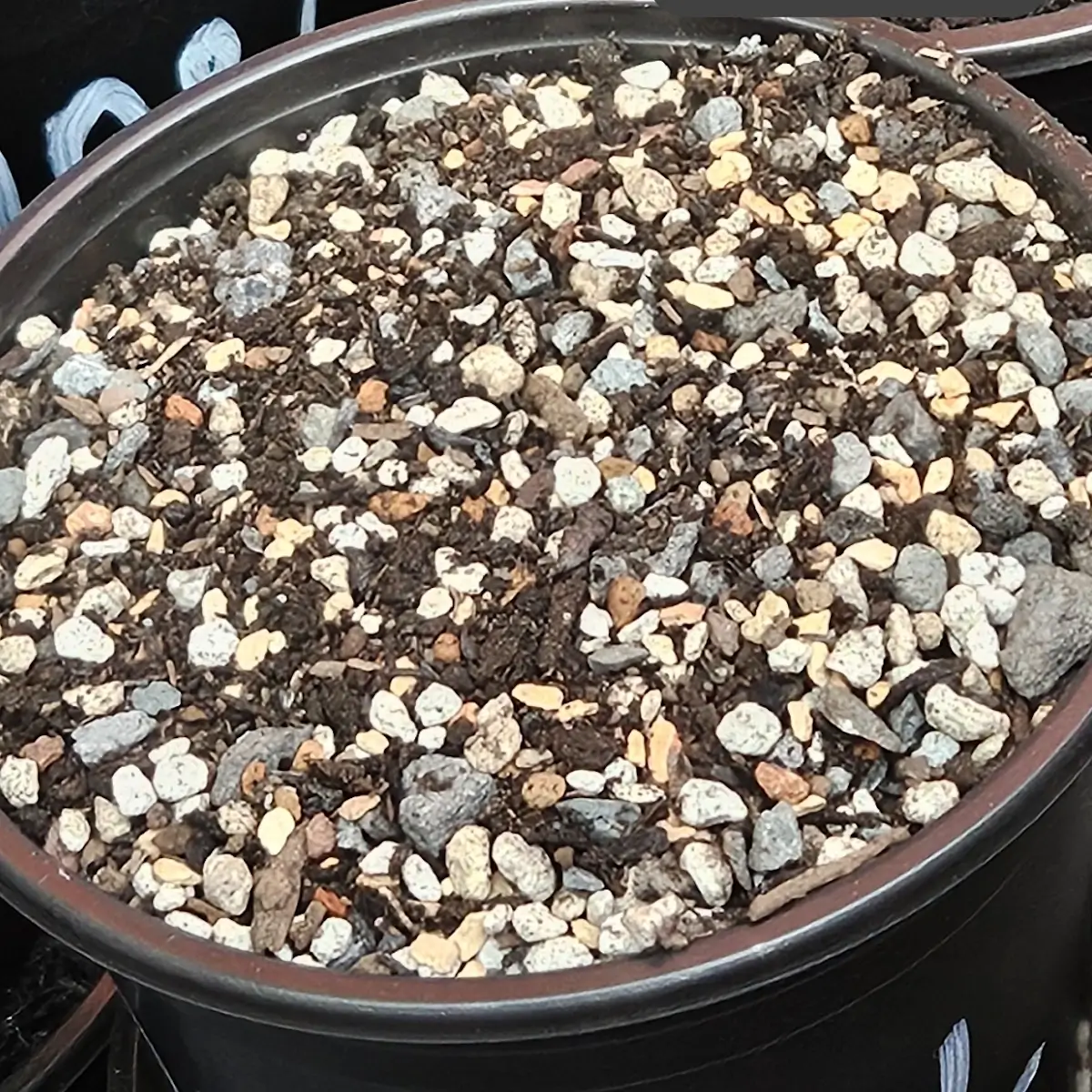
Advanced notes on creating your own soil recipe
Think of it in terms of organic and inorganic. The purpose of the organic portion is to hold moisture and nutrients for the roots to take up, the purpose of the inorganic is to provide air filled porosity, prevent excess compaction, aid drainage, and allow the substrate to dry more quickly.
Organic portion
Go to your local nursery or hardware store and check the ingredients sections on the bagged soils.
Avoid: Peat and high nitrogen additions like manure and blood meal. I do not recommend peat moss as it has weird water absorption properties, goes acidic over time, and has poor nutrient retention. It is also unsustainably harvested, if that matters to you. “Cactus and succulent soil” as well as miracle gro products are almost always entirely peat and bark with 5% perlite mixed in - no good. I also personally am not a fan of coir due to its low nutrient holding abilities and the fact that it needs to be hydrated and buffered before use, which can be a lot of work where better alternatives are available for the same value. Fox farms products have been delisted from OMRI, contain peat as a primary ingredient, and are a poor value per volume. Aged forest product and similar inclusions seem to be fine for me.
Look for: Humus, Loam, Compost, and other decomposed organic matter. Optionally you can further enrich it by adding in earthworm castings at a ratio of 1:3-1:4 which boost beneficial microbial activity. If you don't want to use synthetic fertilizers and would rather feed your plants with organics, there are a lot of other very optional organic soil amendments you could add to this portion such as alfalfa meal, kelp, fish bone meal, insect frass, etc. I would avoid nitrogen forward amendments such as manure and blood meal. If you don't want to buy a bunch of different amendments and try to do the math to figure out how much of each to add, check out Espoma Citrus tone, which is a premixed selection of these types of amendments at an acceptable nutrient ratio. (Note that each type of tone product and brand of citrus tone has a different ratio and I'm specifically and only recommending Espoma's citrus tone here, which I believe has a good nutrient ratio.)
Whichever organics you end up with, sift it through 1/8 to 1/4 inch mesh to remove large organic chunks that hold excess moisture and decompose long term in the substrate.
If possible, I would recommend composting the organic mix well before using, especially if adding amendments. Put in a large tub with holes drilled in the bottom and a lid loosely covering the top, or in a covered compost pile. Turn and water every two weeks for fastest composting. This will prevent “hot soil” where active decomposition of soil components in a pot spikes nitrogen, increases insect presence, and increases chances of plant pathogens.
Inorganic portion
The goal here is a durable, porous rock with medium-low density that will improve root zone air filled porosity and drainage without making the mix compacted or dense. If you want to use one ingredient, go with pumice, lava/scoria, expanded shale, or hard fired porous clay products, but a mix of these is an improvement. Some porous clay products are sold as Espoma soil perfector (medium particle size) Turface(seedling particle size), Seramis, and LECA- sometimes sold as clay balls/pebbles (large particle size). Optional small portion additions (<5%ea) include zeolite or biochar which improve nutrient holding capacity of the substrate while acting as an inorganic for moisture properties. If you use zeolite or biochar I would suggest presoaking in nutrient solution before adding it. Test the quality of your biochar by testing its pH before pre charging it - quality biochar should be around 7pH.
Avoid: Vermiculite retains too much moisture to use. Sand is bad, causes compaction and density increases while reducing aeration and drainage. Pea gravel, river gravel, or random stones and rocks you find are non porous and not a helpful addition, they will greatly increase density and compaction without adding any benefit. Perlite really retains too much moisture and has too low of density to be a good choice. It will float out of suspension to the top of the substrate over time and even blow out of the pot with light wind when dry, though in a pinch if you are hurting for more suitable options and really can't afford a better alternative it can be used. Larger chunk perlite is an improvement over the cheapest smaller grained stuff.
Optimal inorganic particle size depends on plant size: for seed sowing 1/8“, for seedlings 1/8-1/4”, for yearlings 1/8-3/8“, for adults 3/8”. I'd avoid anything over 1/2” though myself. Optionally, sift and rinse inorganics over top of window screen or mesh to remove fines, dust, sand which will reduce density and compaction.
Substrate Ratio
Organic to inorganic ratio depends on your climate, watering frequency, the species, and pot type. As a general starting point I suggest 65:35 inorganic to organic. If you are going to use terracotta in all but the most wet climates, 50:50 might be better. If growing bridgesii, scopulicola, or monstrose plants you may want extra inorganic, closer to 75:25. If you live somewhere very wet or humid, increase the inorganic portion further.
Layering
Adding a “drainage layer” of rocks to the bottom of the pot actually makes drainage worse, not better, by creating what's called a perched water table. Avoid doing this. Top dressing pots also causes issues with soil drying and makes it more difficult to check soil moisture. For the best soil health, I strongly recommend to only use a single evenly mixed substrate through the whole pot with no layers.
Sourcing
If you're mixing larger volumes of substrate I highly recommend scouting out what ingredients you can find locally at good prices. Buying soil and rocks online gets very expensive due to shipping. Check your local nurseries, garden centers, hydroponics stores, landscape supply yards, and irrigation supply shops. As an example, the best price I can find on 3/8 pumice online is $1.67/qt but locally I can get it for $0.44/qt. Buying in the larger size bags helps a lot too, or if you are mixing a real ton, buying from a landscape supply yard by the yard mixed and delivered is a great value.